Technical deep dives
Below the pricing tables sits a smaller set of technical questions that tend to decide whether a packaging switch works in practice: what a certification actually certifies, why one cushioning material collapses where another one springs back, and how a print job gets set up on a roll of tape. These sections go a level deeper than the homepage comparisons.
What "compostable" is actually certifying
Most compostable mailers sold into the European market are built from a blend of PBAT, a biodegradable polyester, and PLA or a starch-based filler such as corn starch, formulated so the finished film behaves mechanically like a conventional poly mailer while breaking down under specific conditions afterward. The certification most commonly cited on these products, EN 13432, does not simply mean a material will rot away in a garden compost heap over a season. It specifies that the material must disintegrate into fragments smaller than two millimetres within twelve weeks and biodegrade at least ninety percent within six months under controlled industrial composting conditions, meaning elevated temperature, humidity and microbial activity that a typical Czech household compost bin rarely reaches on its own. A separate mark, often labelled OK compost HOME, applies a stricter and slower test intended to reflect genuine home composting conditions, and considerably fewer mailers on the market currently carry that particular certification compared with the industrial standard.
This distinction matters practically because industrial composting infrastructure for packaging waste is still expanding in the Czech Republic, and a compostable mailer that ends up in a general municipal waste stream without access to an industrial facility will not compost in any meaningful sense, behaving instead much like any other piece of discarded film. Some converters address this by printing clear disposal instructions directly onto the mailer itself, directing the customer toward a biowaste or municipal composting stream where one exists locally, which is a detail worth checking when comparing suppliers rather than assuming compostability alone solves the end-of-life question.

Why paper cushioning protects through a different mechanism
Standard bubble wrap protects a product by trapping air inside sealed polyethylene cells that compress under impact and then largely spring back to their original shape, spreading the force of a drop or a knock over a short span of time. Paper honeycomb wrap and molded pulp trays work through structural collapse instead: the material is engineered to crumple, fold or crush in a controlled way, absorbing the same impact energy but without returning to its original shape afterward, which is why a used sheet of honeycomb wrap looks visibly flattened where bubble wrap often looks nearly untouched. Neither mechanism is inherently better at protecting a given item, but they behave differently depending on the number of times a parcel is handled and dropped through a courier network, and on whether a single hard impact or several smaller repeated knocks is the more likely risk for a particular product category.
For genuinely fragile items, glass, ceramics or delicate electronics, a molded pulp tray shaped to the exact product tends to distribute pressure more predictably than a generic wrap of any material, because it constrains movement inside the box rather than relying purely on absorbing an impact after it has already begun.
Flexographic plates, digital print and where the cost sits
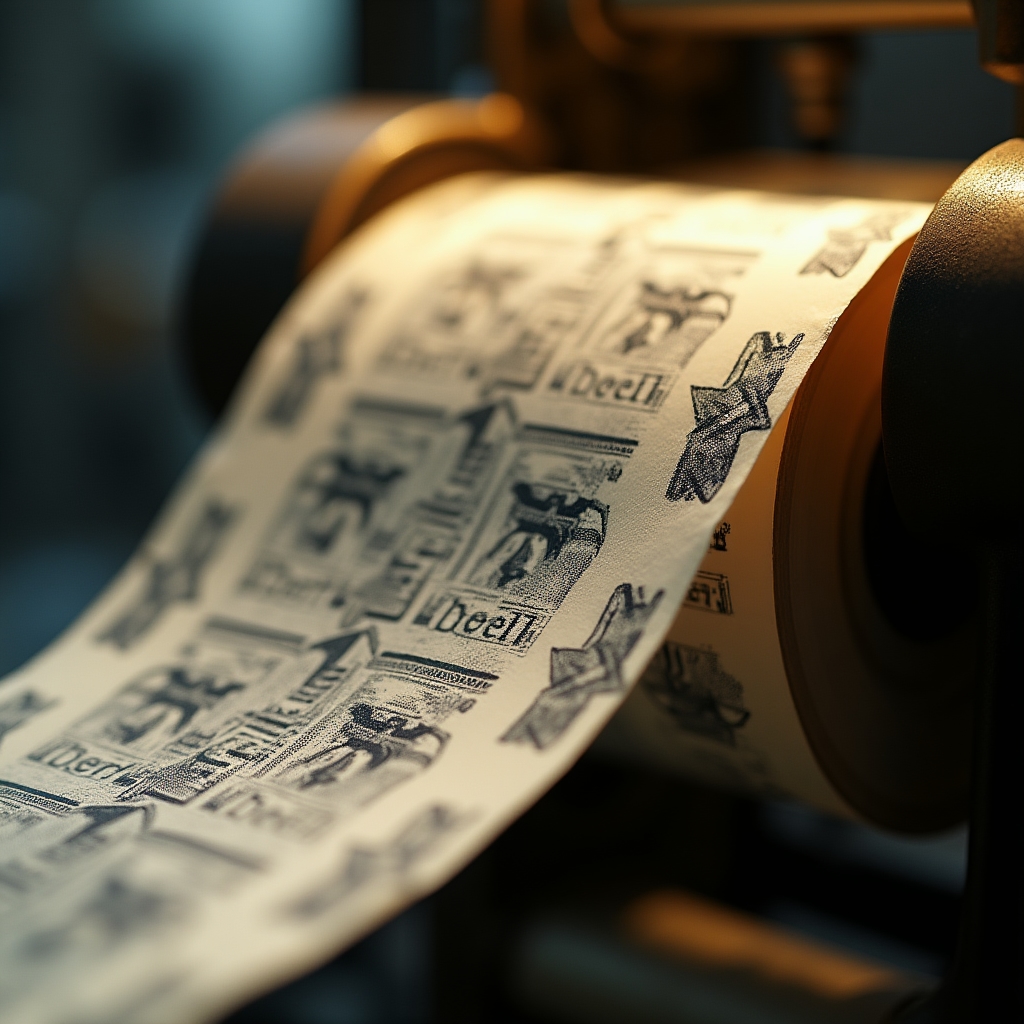
Printing a logo onto a roll of tape, whether vinyl or paper, is most commonly done with flexographic printing for longer runs, a process that presses ink onto the material using a raised rubber or polymer plate mounted on a cylinder, one plate per colour used in the design. Setting up those plates is a fixed cost regardless of how many rolls are eventually printed, which is why converters typically quote it separately from the per-roll price, and why a two-colour design costs meaningfully more to set up than a single colour logo printed in one ink. Shorter runs, sometimes below a thousand rolls, are increasingly handled with digital print instead, skipping the plate entirely at the cost of a slightly higher per-roll rate, which can work out cheaper overall for a business testing a new design before committing to a larger flexo run.
Water-activated gummed paper tape runs slightly slower through most industrial print lines than smooth BOPP film, since the paper substrate absorbs ink differently and needs to dry before the roll can be wound, and that slower run speed is part of why paper tape print jobs are typically quoted at a somewhat higher per-roll price than an equivalent vinyl run even before the raw material cost difference is factored in.
Why the adhesive matters as much as the material
A cardboard box carrying a plastic-based tape or a plastic laminate window is not automatically excluded from recycling collection in the Czech Republic, but it typically requires an extra sorting step at the paper mill, where mechanical screens or manual pickers remove non-fibre contamination before pulping begins. Enough contamination across a batch and the whole load can be downgraded to a lower grade of recycled fibre, which is one of the quieter reasons some paper mills and recycling advocates have pushed packaging suppliers toward mono-material construction, meaning a box, its tape and any window should ideally all be the same base material rather than a mix that has to be separated later.
This is also where some products marketed loosely as paper packaging fall short of the claim on closer inspection. A paper mailer laminated internally with a thin plastic film for extra strength or moisture resistance will not compost or recycle as cleanly as its outer surface suggests, since the lamination has to be separated from the paper fibre first, a step most standard paper recycling processes are not set up to do economically. Checking a converter's technical data sheet for the phrase mono-material or single-substrate is a reasonably reliable way to confirm a paper mailer is built the way its marketing implies, rather than taking the word paper on its own as sufficient information.